
CIMA+
Montreal, CANADA
M.Sc., Civil Engineering | 2015-2017
Polytechnique Montreal
Advisor: James-A Goulet
Engineering Diploma | 2013 - 2015
ESTP : Ecole Spéciale des Travaux Publics, Paris, FRANCE
Project
Title: Probabilistic Modeling of Laboratory Experiments Using Gaussian Process Regression with Hidden Covariates
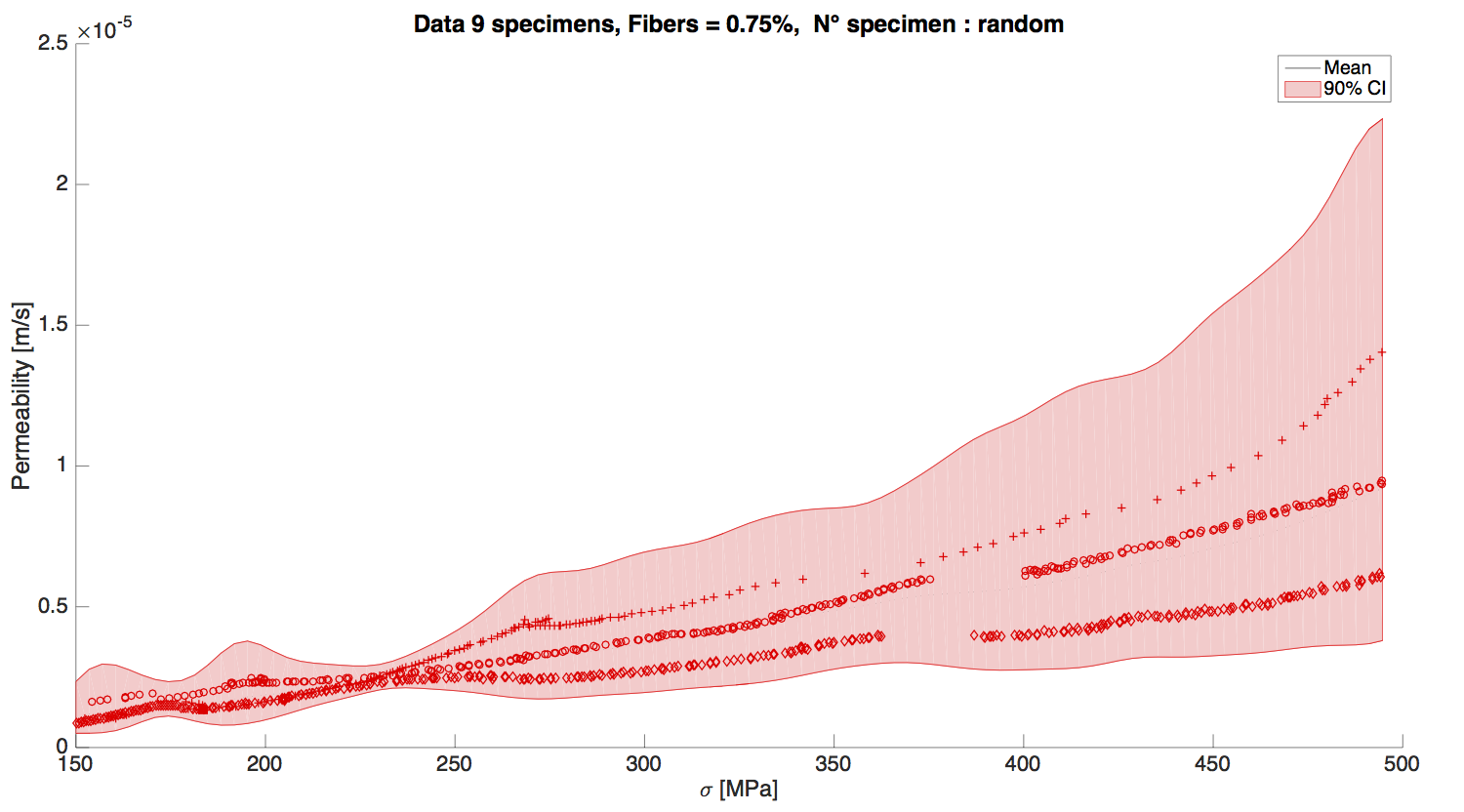
Summary: This project aims at modelling probabilistically the permeability of fibre-reinforced concrete samples. To do so data collected from tensile tests is employed: the stress and the percentage of fibers are the covariates (input data) and quantity predicted is the permeability (output data). The methodology employed is based on Gaussian Process Regression which allows probabilistic interpolation and extrapolation. In this project, the standard Gaussian Process Regression formulation is enhanced to account for the effect of unmeasured covariates (hidden covariates). Permeability does not only depend on stress and percentage of fibers but on other parameters as well, such as quantity of cement or granulate. These parameters, which are often not possible to measure, must be taken into account through hidden covariates in the covariance function. This model provides the permeability’s mean with its confidence interval. This method can be employed to extrapolate the permeability of new concrete samples using in-situ data where a single sample observation is available for a given stress and percentage of fibers.
[2018] Probabilistic Modeling of Heteroscedastic Laboratory Experiments Using Gaussian Process
Regression
Tabor, L. Goulet, J.-A., Charron, J.-P., Desmettre C
Journal of Engineering Mechanics. Vol. 44, Issue 6, pp. 04018038
[PDF] [EndNote] [BibTeX] [DOI link]
[2017] Modélisation probabiliste d'essais en laboratoire par processus Gaussien avec peu de spécimens
répliqués
Tabor, L.
M.Sc. Thesis, Polytechnique Montréal
[PDF] [EndNote] [BibTeX]
[2017] A machine learning approach for characterizing soil contamination in the presence of physical site
discontinuities and aggregated samples
Quach, A., Tabor, L., Dumont, D., Courcelles, B., and Goulet, J.-A..
Advanced Engineering Informatics., vol.66, pp. 60-67.
[PDF] [EndNote] [BibTeX] [DOI link]